Thursday, March 12, 2015
Just because I have to write a review
Hillary Clinton has been in politics for years, from the first lady to the New York State senate back to the White House in the role of Secretary of State. Yet, the thing that she has been unable to reach is the Presidency of the country. In 2008 she was defeated in her own democratic party by President Obama and all eyes watched as she seemed to stray from the spotlight. This book by Jonathan Allen and Amie Parnes seeks to capture the fall and the rise of HIllary Clinton- from defeat to becoming one of the strongest candidates for 2016. It follows Hillary as she reinvents herself for a new generation of voters. An interesting political read on the person who is currently in all the headlines.

Thursday, February 26, 2015
Q&A a day
 Q&A a day by Potter Style is a five-year journal that has 365 different questions to answer. Each day you write your answer to the question and every year for five years you are able to see how your answers have changed. If you are anything like me than you have multiple journals that were once started with good intentions but are now lying dormant and unused around the house.
It seems like every year I get a new journal because of my love for writing but I always run into the same problem- those days when I just don't have a clue what to write about, well now there is no need to get stuck. All you have to do is answer the question that has so kindly been given to you every day. Now you can have five years of knowing exactly what to write!
Sample Questions:
- "What is your mission?" (Jan. 1st)
- "What are you reading right now?" (Jan. 3rd)
- "What song is stuck in your head?" (Jan. 8th)
- "What inspired you today?" (Jan. 10th)
- "Do you owe someone money? Does someone owe you?" (Jan. 16th)
An extremely enjoyable little journal that will make it easier to keep up the habit of daily writing, and if five years isn't enough to be consistent at something than Potter Style now has a variety of these kinds of journals, such as: Q&A a day 3 year journal for 2 people, Q&A a day for kids a 3 year journal, and even Q&A a day for teens a 3 year journal.
"I received this book from Blogging for Books for this review."
"I received this book from Blogging for Books for this review."
Wednesday, February 18, 2015
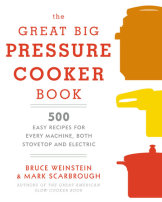
The Great Big Pressure Cooker Book
The Great Big Pressure Cooker Book by Bruce Weinstein and Mark Scarbrough is filled with five-hundred recipes that are made with electric or stove-top pressure cookers. The book caught my eye because being that I now live in Costa Rica the pressure cooker is a main kitchen tool. Granted, the first time I saw one I had no idea what it was, then when I saw the steam pouring out I thought for sure it was going to explode! Yet, no worries if you're like me and had never seen a pressure cooker which ultimately caused you to fear for your life- or at least for some serious burns; the whole first half of the cookbook is dedicated to people like us.
 The first half includes an introduction on what a pressure cooker is, the different models that are available, and fantastic advice on making sure to read the instruction manual that comes with your pressure cooker because every model is different. Trust me, after reading the introduction I found myself much more at ease that I could cook with a pressure cooker without burning myself with steam or blowing my house up (maybe a slight exaggeration but hey when you're scared you imagine crazy things).
"I received this book from Blogging for Books for this review."
 The first half includes an introduction on what a pressure cooker is, the different models that are available, and fantastic advice on making sure to read the instruction manual that comes with your pressure cooker because every model is different. Trust me, after reading the introduction I found myself much more at ease that I could cook with a pressure cooker without burning myself with steam or blowing my house up (maybe a slight exaggeration but hey when you're scared you imagine crazy things).
Anyways, once you get that confidence boost from the first half of the introduction you can move on to the practical advice in the second half on cooking. They recommend how much salt, liquid, even how big the vegetable pieces should be cut to make sure they are all evenly cooked. It contains great practical advice which is very specific depending on whether you have a stove-top model or an electric model.
The recipes are broken down into seven main sections: Breakfast, Soups, Meat, Poultry, Fish and Shellfish, Vegetables, Beans, and Grains, as well as, Desserts. These main categories are divided further into sub-categories, such as, chicken, turkey, beef, main course soups, and vegetable or grain soups.
Overall, a very thorough and practical book on using what should become a main staple kitchen tool. It allows for delicious meals in a much quicker amount of time- think in terms of the results you would get from using a slow cooker all day but now in the time of about 30 minutes.
Tuesday, February 10, 2015
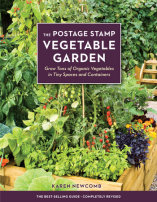
The Postage Stamp Vegetable Garden
The Postage Stamp Vegetable Garden by Karen Newcomb is a fantastic book on creating gardens in small spaces- from small patios to small containers that can be used to create herb gardens. The whole point is to maximize the modest space to create the largest amount of vegetables. Another unique feature is that the whole process from the soil to unwanted pest control is done organically.
 The book is broken down into eight chapters: Chapter one is dedicated to planning your garden and serves to answer the questions, "how, what, when, where"; Chapter two looks at how to prepare the soil for your garden; Chapter three focuses on how to prepare the ground which is an extremely important part of the process, think of it as the foundation of a house; Chapter four targets more in depth the "when and how" to plant which is equally important because if you are currently in the frozen tundra of the North Eastern United States it may be a little difficult to plant anything right now, perhaps for the next three months you could hibernate in the "planning" stage; Chapter five centers on how to water your garden; Chapter six is a fantastic little chapter that plans out delicious herb gardens; Chapter seven is committed to "getting along", in other words, what plants grow best together; and finally Chapter eight focuses on how to get rid of the nasty critters that would like to eat our garden before we get the chance.
Also included in the Appendix are the topics: "How to Compost" and "Seed Sources". The latest edition due to release February 17, 2015 contains the extra insight on heirloom seeds which allow you to save the seeds from the original plant and use them next season to create the same vegetables. Overall, an in-depth and insightful look at organic gardening within confined spaces.
Also included in the Appendix are the topics: "How to Compost" and "Seed Sources". The latest edition due to release February 17, 2015 contains the extra insight on heirloom seeds which allow you to save the seeds from the original plant and use them next season to create the same vegetables. Overall, an in-depth and insightful look at organic gardening within confined spaces.
Friday, February 6, 2015
The Prayer of the Lord
 In our world of "instant" everything, I have found the discipline of prayer to be extremely difficult. Even at times I wondered what was ultimately the purpose since God is sovereign, all-knowing, and all-powerful. However, Jesus had commanded us as his followers to pray and even assured us that He is ever interceding for us. Yet, more often than not prayer seemed like a thing people used to tell God what they wanted or what He ought to do for them. So as I looked through Reformation Trust, I came across The Prayer of the Lord by R.C. Sproul. This book analyzes the Lord's prayer found in the Gospels.
As the author points out, it is interesting that out of the many questions the disciples could have asked Jesus, the one question that was most important to them was, "Teach us to pray." For me that is comforting to know that even the disciples who spent time walking and being taught by Jesus needed to know how to pray. Even before Jesus begins to teach them how to pray, He tells them not to pray as hypocrites or with vain repetition. Also contained in the first chapter is the answer to the question, why pray since God is all-knowing?
At that point, I have to remind them that, as I mentioned above, prayer does change things, all kinds of things. But the most important thing it changes is us. (pg.14)In the Lord's prayer the first thing we don't see- is ourselves. Jesus speaks of "Your name, Your kingdom, and Your will". The last thing that we see is ourselves which combats our self-worshiping generation. When one has grown so accustomed to looking out for himself before anyone else it is difficult to focus your attention on someone else. Yet, this exactly what Jesus is teaching us, to focus our eyes on the Father. There is nothing easy about taking up your cross and following, but this is what He has called us to. Why? because God is the ultimate treasure of our souls and only in Him can we find our greatest joy.
The second chapter envelops "Our Father in Heaven" and what fascinated me was the study done on the use of the word "Father" to refer to God in the Old Testament. There is not a single instance of any Old Testament writer referring to God as Father. Yet, just as shocking is the fact that Jesus referred to God as Father every time he prayed except once. He was issuing in a change in the way we can pray as adopted children.
If you are struggling with the discipline of prayer or are concerned with your own questions about "why pray?" then I would strongly encourage you to study the Lord's prayer and also to use this book as a guide to help you enjoy the sweetness of communion with "Our Father".
*I will receive this in hard copy for writing a blog review.
Tuesday, February 3, 2015
Clean Slate: A Cookbook and Guide

Clean Slate is a cookbook compiled and created by the editors of Martha Stewart Living. The cookbook is one of their newest releases and features recipes to strengthen and rejuvenate the body. The goal is not only to provide delicious recipes but also to change the mindset of the reader- helping them to consider more carefully what kind of food they ought to be eating. For this reason, the book has been divided into two parts: section one is called "reset" dealing with healthy nutrients, pantry stocking, and detoxing; while section two contains recipes which cover a variety of topics, such as; breakfast, drinks or smoothies, and snacks.
In Part One, basic rules are set forth:
- Choose whole foods over processed
- Embrace a plant based diet
- Practice mindful eating
- Engage in an active lifestyle
- Boost energy with lean protein
- Pay attention to how you feel
One of my favorite features is found in pantry stocking which not only tells you what you should have stocked, but also how to cook the items yourself rather than depending on processed substitutes. Included are recipes for almond milk, chicken stock, and harissa.
Another helpful feature is located at the end of the cookbook which shows which recipes are vegan or gluten free depending on what are your dietary needs.
"I received this book from Blogging for Books for this review."
Monday, February 2, 2015
Sammy and His Shepherd
Sammy and His Shepherd by Susan Hunt and illustrated by Cory Godbey is a children's book based on Psalm 23. There are eleven chapters in the book with each chapter enveloping a section from the passage of Psalm 23.

The story begins with Sammy the sheep who notices a suffering little sheep from another pasture. As they begin to talk Sammy realizes that he has a good shepherd who cares for his flock, but this other sheep doesn't seem to have anyone that cares for it.
After their first meeting they quickly become friends and each day they find themselves hanging out by the fence talking with each other. However, Sammy fears for his friend because it is apparent that he is not eating well because the pasture he lives in has very little grass left and the water the shepherd brings them to is dirty and filthy.
Yet, each day Sammy learns the characteristics that his good shepherd has that he had never noticed before talking with the sheep from the other pasture. Sammy had thought that every shepherd was like the one he had!
The book is not set up to read in one sitting, and would be more useful as a daily reading for a family devotion time or for bedtime reading. It is set up to go slowly through each chapter and then read the discussion questions at the end of the book. Overall the book is enjoyable and the illustrations are colorful and engaging for younger children.
*I will receive a hard copy of this book from the publisher for writing a review.
Wednesday, January 28, 2015
Believing God

Believing God by R.C. Sproul Jr. describes twelve promises given in scripture that many Christians endeavor to understand, to believe, and to live out in their daily lives. A very interesting part of the book is the preface, which contains a very personal look into the life of the author. He attempts to make it clear that his purpose in writing the book is because he often fails to believe God in these areas and gives as an example a difficult time of his life when he needed above all things to believe God. The preface is worth reading first because it gives a clarity to the content of the book.
The Sixth chapter envelopes the promise found in Psalm 37:4, the desires of your heart. This promise has been twisted to say things that it was never meant to say. We must go back to the ultimate purpose of man- that our lives should bring glory to the Father. Although it is easy to say, how do we practically go about bringing glory to God and making him the true desire of our heart? How do we develop the pray of Augustine, "our hearts are restless, O Lord, until they find their rest in Thee."?
This has been one of my favorite books to read from Reformation Trust publishing, the writing is very engaging and even reminds me a little of C.S. Lewis. He is able to take a deep theological truth and make it understood through the simple things that we see, hear, and touch throughout the day. These are promises that at times need to be clarified- but that we need to hold to constantly.
*I will receive a copy of the book from the publisher for writing a review.
The First chapter conquers the promise that "all scripture is profitable". The author begins with the question, "where did it all go wrong?" and explains that many have their minds fixed only in decades, but ultimately that question goes back to Genesis where Eve ate the fruit and gave to her husband with her.
In the same manner, as noted above, we look at the progress of the kingdom of God in terms of decades rather than centuries. While things may not be as good here as they were fifty years ago, we would be wise to remember that four hundred years ago you could count the number of those on this continent who were, by God’s grace, among the flock of God on your fingers and toes. The conquest of all things by Jesus is not a straight, ascending line. Rather it is like a stock ticker that has both ups and downs, and yet has an upward trend. (pg.2-3)The Third chapter deals with confession, forgiveness, and cleansing. He starts with the false teaching that began with a man named, Pelagius. He rejected the doctrine of original sin and believed that man was able to complete all of God's laws, even the one that tells us to be perfect as He is perfect. The problem is that this idea is still prevalent today, it comes out of a false interpretation of Rom. 3:23 "for all have sinned, and come short of the glory of God." We read the last half and think of it as a marathon runner who could see the finish line in his sight, but falls just before crossing because of exhaustion. So close- but so far. Yet, this is a completely false picture from what the Bible teaches us. The picture ought to look more like a marathon runner who isn't even on the path! We don't come anywhere near to the glory of God! This is why confession is so important, we must confess that we are filled with sin, that we are unable to remove the sin from our hearts, and that only through the imputed righteousness of Christ can we be made clean.
The Sixth chapter envelopes the promise found in Psalm 37:4, the desires of your heart. This promise has been twisted to say things that it was never meant to say. We must go back to the ultimate purpose of man- that our lives should bring glory to the Father. Although it is easy to say, how do we practically go about bringing glory to God and making him the true desire of our heart? How do we develop the pray of Augustine, "our hearts are restless, O Lord, until they find their rest in Thee."?
This has been one of my favorite books to read from Reformation Trust publishing, the writing is very engaging and even reminds me a little of C.S. Lewis. He is able to take a deep theological truth and make it understood through the simple things that we see, hear, and touch throughout the day. These are promises that at times need to be clarified- but that we need to hold to constantly.
*I will receive a copy of the book from the publisher for writing a review.
Tuesday, January 27, 2015
The Priest with Dirty Clothes
The Priest with Dirty Clothes is a children's book written by R.C. Sproul and illustrated by Justin Gerard about the theological concept of justification. It is based on the passage of scripture in Zechariah 3:1-5. The author attempts to illustrate for children the concept of Christ removing our filthy garments of sin while placing upon us his righteousness garments so that we can be accepted by the Father. The concept is of vital importance and although it is a difficult subject to explain, the visual of outward clothing will help children to understand the "dirt" or sin of the heart that cannot be removed by one's own power.
The story begins with Darby and Campbell who find themselves on a rainy day in Scotland playing in the puddles. Soon they are covered with mud and hurry home to surprise their Mother. She of course is not happy to see her children's filthy clothes and tells them to go clean themselves, while the children are rinsing their Grandfather arrives. He begins to tell them a story about Jonathan, a man who was just about to become a priest. He was so excited to receive his brand new clothing and because he had been told that in a week who would preach for the King and all his household.
The day that Jonathan traveled to the castle there was a great storm and it was raining very hard- his horse stumbled causing Jonathan to fall into a great puddle of mud. Although he had tried to protect his new clothes, they were filthy from the mud. How could he preach for the King now? He continued to hurry to the castle in hope that he would be able to wash himself before he had to preach. Unfortunately, this was not the case because on the moment of arrival the bells began to ring announcing that it was time for him to preach. In shame he walked before the King and all the people in his dirty clothes, only to find the court magician yelling hateful things at him! Telling him that he had no right to stand before the King and all the people in his dirty clothes.
The King was more patient and kind than the magician and listened to the reason why Jonathan had come to the palace in his dirty robes. Yet, he too told Jonathan that he could not stand in front of Him with such dirty clothes, however, he gave Jonathan a second chance to return in a week with his clothes cleaned and then he could preach to the King and to his household.
Jonathan left hopeful and hurried home to clean his clothes. Despite all his effort the clothes were still dirty and stained. He took them to be washed but the cleaner also could not remove the stains! What could Jonathan do? He was running out of options.
This is the same position we find for our filthy hearts, despite our best effort we are unable to clean it. There was one more person that Jonathan would appeal to for help, the Prince. The Prince is also the answer to our own filth problem because as you will see in the story, he was the only one who could help Jonathan's situation. Yet, he didn't clean Jonathan's old garments because he would do something even more necessary and special for Jonathan.
Monday, January 26, 2015
Parenting by God's Promises
Parenting by God's Promises is by Joel R. Beeke and is a shorter compilation of a teaching series he did with his Family Living Class in Grand Rapids, Michigan.
In total the book contains twenty-two chapters that are split into four parts:
In total the book contains twenty-two chapters that are split into four parts:
- Part One: Covenantal Foundations for Parenting
- Part Two: Parenting as Prophets, Priests, and Kings
- Part Three: Practical Steps for Child-Rearing
- Part Four: Practical Helps for Teenagers
Part One begins with the explanation of the covenant God made with Abraham in Genesis after he had fallen into a deep sleep. The idea is to remind parents that ultimately anything that is accomplished with your children is only through the grace of God. The idea is to walk by faith, finding your rest in the God who keeps his covenants. Also included in part one is the admonition to live out your faith actively in the home- to not only talk about Christ to your children but to also show them your obedience to Christ.
Part Two breaks down a parents responsibility in regard to raising their children in a Christ-centered home. The first responsibility is as prophet- to teach them the word of God, the second is as priest- to pray for them, and the third as king- to help children understand the God-given authority a parent has to instruct them. Every other chapter in Part Two is a further explanation of these concepts along with practical advice for living these ideas out in the home.
Part Three contains the Biblical roles of husband, wife, and children in the home. The author also mentions the importance of teaching children the importance of piety, how to listen, and taming the tongue. Also included in part three is advice on nurturing sibling relationships.
Part Four is meant for children who are older and in a position to begin making their own decisions. It begins with the importance of the child discovering for themselves God's will. Other topics mentioned are peer pressure and anger.
The book itself is an extremely thorough explanation of the role of covenant theology in parenting, as well as, a lot of practical advice for daily living.
Part Two breaks down a parents responsibility in regard to raising their children in a Christ-centered home. The first responsibility is as prophet- to teach them the word of God, the second is as priest- to pray for them, and the third as king- to help children understand the God-given authority a parent has to instruct them. Every other chapter in Part Two is a further explanation of these concepts along with practical advice for living these ideas out in the home.
Part Three contains the Biblical roles of husband, wife, and children in the home. The author also mentions the importance of teaching children the importance of piety, how to listen, and taming the tongue. Also included in part three is advice on nurturing sibling relationships.
Part Four is meant for children who are older and in a position to begin making their own decisions. It begins with the importance of the child discovering for themselves God's will. Other topics mentioned are peer pressure and anger.
The book itself is an extremely thorough explanation of the role of covenant theology in parenting, as well as, a lot of practical advice for daily living.
Friday, January 23, 2015
A View of American Churches from an Outsider
"This is quite characteristic of most of the churches I saw. So what stands in place of the Christian message? An ethical and social idealism borne by a faith in progress that- who knows how- claims the right to call itself "Christian." And in the place of the church as the congregation of believers in Christ there stands the church as a social corporation. Anyone who has seen the weekly program of one of the large New York churches, with their daily, indeed almost hourly events, teas, lectures, concerts, charity events, opportunities for sports, games, bowling, dancing for every age group, anyone who has heard how they try to persuade a new resident to join the church, insisting that you'll get into society quite differently by doing so, anyone who has become acquainted with the embarrassing nervousness with which the pastor lobbies for membership- that person can well assess the character of such a church. All these thing, of course, take place with varying degrees of tactfulness, taste, and seriousness; some churches are basically "charitable" churches; others have primarily a social identity. One cannot avoid the impression, however, that in both cases they have forgotten what the real point is."
- Written by Dietrich Bonhoeffer in 1930.
- Written by Dietrich Bonhoeffer in 1930.
Friday, January 9, 2015
The Prince's Poison Cup
The Prince's Poison Cup is another children's book written by R.C. Sproul. This has been one of my favorites to read so far, from the fantastic illustrations to the intriguing plot it will keep anyone engaged in the story. The plot is based on Jn. 18:11, "Shall I not drink the cup that the Father has given me?"
In the usual fashion of R.C. Sproul's books written for children; the tale begins with a little girl, Ella. However, Ella has a terrible sickness and doesn't understand why the medicine meant to make her feel better has to taste so bad. So as any little child she asks her Father that questions, to which he responds that it would be better to wait for Grandpa to come.
Once Grandpa comes he begins to share with Ella the story of the King of Life who had a beautiful park filled with happy people. Yet, there was one rule in this jubilant park- in the middle of the town was a crystal clear fountain, but the King warned his subjects that they were not allowed to drink from this fountain. Since there were many streams in the park the people for a time were content with not drinking from the fountain, but soon they became curious about this enticing fountain.
Disastrously, the King's archenemy comes to the park and begins to convince the people that there is nothing wrong with the fountain and that the King of Life unfairly wants to keep the best for himself.
The people are enraged by this and decided to drink from the fountain that the King had commanded them not to. Then a terrible thing happens, the people's hearts are turned to stone and they no longer love or want to be with their King. So they decided to leave the park and build their own city away from the King of Life.
The King of Life is angry when he sees what the people have done and would be completely just to destroy the people and their city since he had commanded them not to drink from the fountain. Yet, the King still loved his people and has a plan that involves his son, the Prince- and a terrible poison cup.
You will have to buy the book yourself to find out what happens to the Prince in his journey to the City of Man, but I have never read a children's book that so clearly details the truth of Jesus Christ in a way that even children will be able to comprehend. I found myself as an adult, thinking and meditating on the passages in John and about the wonderful mission that Christ completed when he came to earth and drink the bitter cup of God's wrath to save man's heart of stone.
In the usual fashion of R.C. Sproul's books written for children; the tale begins with a little girl, Ella. However, Ella has a terrible sickness and doesn't understand why the medicine meant to make her feel better has to taste so bad. So as any little child she asks her Father that questions, to which he responds that it would be better to wait for Grandpa to come.
Once Grandpa comes he begins to share with Ella the story of the King of Life who had a beautiful park filled with happy people. Yet, there was one rule in this jubilant park- in the middle of the town was a crystal clear fountain, but the King warned his subjects that they were not allowed to drink from this fountain. Since there were many streams in the park the people for a time were content with not drinking from the fountain, but soon they became curious about this enticing fountain.
Disastrously, the King's archenemy comes to the park and begins to convince the people that there is nothing wrong with the fountain and that the King of Life unfairly wants to keep the best for himself.
The people are enraged by this and decided to drink from the fountain that the King had commanded them not to. Then a terrible thing happens, the people's hearts are turned to stone and they no longer love or want to be with their King. So they decided to leave the park and build their own city away from the King of Life.
The King of Life is angry when he sees what the people have done and would be completely just to destroy the people and their city since he had commanded them not to drink from the fountain. Yet, the King still loved his people and has a plan that involves his son, the Prince- and a terrible poison cup.
You will have to buy the book yourself to find out what happens to the Prince in his journey to the City of Man, but I have never read a children's book that so clearly details the truth of Jesus Christ in a way that even children will be able to comprehend. I found myself as an adult, thinking and meditating on the passages in John and about the wonderful mission that Christ completed when he came to earth and drink the bitter cup of God's wrath to save man's heart of stone.
Monday, December 15, 2014
The Christian Lover

"The Christian Lover" by Michael A.G. Haykin with Victoria J. Haykin is a compilation of love letters written by believers. It contains the correspondence of Martin and Katharina Luther, Adoniram and Ann Judson, along with many others.
The idea of the book is extremely interesting, it allows the reader to see a different perspective of people like John Calvin through the letters he wrote to friends and family about the death of his wife. It grants one to see closely what a marriage whose center is Christ ought to look like- to see the husband loving his wife as Christ loved the church and also to see the wife submitting to her husband as Christ submitted his will to the Father's.
The outline of the book is simple, each chapter is a different marriage and begins with a brief history of each writer, which is then followed by a few personal letters. The writing style is uncomplicated and gives a very brief overview- almost a little too short. The difficult thing about reading letter's written by and to other people is that at times it is difficult to understand the context behind the letters. Although that is perhaps one of the negative things about this book, it could be used in a positive sense as well- to encourage the reader to look into other biography's about the marriages found in "The Christian Lover". Although it is filled with many famous believers that you might have heard of before, there are few that I didn't recognize and was in fact encouraged to look into the lives of the couples to find out the background of the letters that I was reading.
It is a shorter book and will only take a little time to read through the letters. I would recommend the book to any couple as it is encouraging and uplifting.
*I will receive a hard copy of the book for writing a blog review.
Friday, December 12, 2014
Are We Together
"Are We Together" by R.C. Sproul analyzes the relationship between Protestants and Catholics. With the formation of the term "Evangelicals" both are commonly grouped together, so are we together? This book attempts to prove the differences between the two groups and the importance of why "evangelicals" need to know what they believe and why they believe it.
Sproul begins with the introduction; At Stake: The Gospel. Strong words for a topic of utmost importance. It is not just a talk about differing denominations there is something at stake in all of this- the person and work of Jesus Christ. The Gospel is divided into two sides, subjective and objective. The objective side envelopes things, such as, the divinity of Jesus or the virgin birth- to this side there is no disagreement between Protestants and Catholics; however, the subjective side envelopes how the benefits of Christ are applied to the believer and this is where the disagreement exists.
The disagreement begins with the question "What must a man do to be justified?" Both the Protestant and Roman Catholic would answer that justification is through faith; however, the Protestant would say through faith alone while the Roman Catholic would say that a person can have real faith but not be justified, that a person's justification depends on their sanctification. Whereas, the Protestant believes that justification is based on the imputation of Christ's righteousness to the believer.
R.C. Sproul argues against the idea that the Reformation has ended because he defines the Reformation as "a commitment to biblical truth, and as long as there are departures from biblical truth, we have to be involved in the task of reformation." (pg.8).
In Chapter One: Scripture, the topic underlined is the formal cause of the Reformation. Although the disagreement focused on justification, it began with a more serious argument. What or who has the authority? This issue is not easily described in a few sentences and the author has worked hard to show clearly why the two side differ in matters of canon, inspiration, and authority.
Chapter Two: Justification takes a closer and more in-depth look at the crucial difference between Protestants and Roman Catholics.
Chapter Three: The Church seeks to emphasize the different beliefs that Roman Catholics and Protestants have over the relationship of the church to salvation.
Chapter Four: The Sacraments highlights the variance between the Roman Catholic view and Protestant view of the sacraments. However, the author is clear to point out that even admist Protestant churches there is disagreement over the nature, function, and significance of the various sacraments.
Chapter Five: The Papacy covers the formal definition of papal infallibility. It contains valuable information on the history and beliefs of the Roman Catholic Church.
Chapter Six: Mary speaks of the agreements and disagreements that Roman Catholic's and Protestant's have about Mary the mother of Jesus.
The book is filled with valuable historical and doctrinal information about Protestants and Roman Catholics. In a world that desires to put all "Evangelicals" it is always important to remember the differences that are between the two groups. Although there may be important social views that are held in common, but for those we cannot sacrifice the truth of the gospel.
*I will receive a hard copy of the book for writing a blog review.
Friday, November 28, 2014
The Lightlings

The newest book that I have been reading is The Lightlings by R.C. Sproul. It is a short children's story based on I Jn. 1:5, "God is light and in Him is no darkness at all." The story is well illustrated and has many pictures to entertain smaller kids.
The story's main character is Charlie, a little boy who finds he has a terrible fear of the dark. He asks his Grandpa to explain how he can conquer his fear of the dark. Quickly, he finds that not only are some people afraid of the dark, but that many people are afraid of- the light! This is where are story takes a twist and spiritual truths begin to appear in the story of the creatures called lightlings.
In R.C. Sproul's unique way, he begins to weave out the truth of redemption in a way that children can understand. He talks about the King of the Light and the creatures that he created. However, his creation would turn against him and disobey. Their action of disobedience would cause them to lose their light and be left in horrible darkness. However, their fear of the King would keep them hiding and stumbling in the darkness.
Will the lightlings ever be able to regain their light or will their fear and shame of their disobedience keep them paralyzed in the darkness? and will Charlie ever learn how he can overcome his fear of the darkness? As Grandpa continues his story you will be able to find the answer to these questions.
At the end of the story there are multiple questions to discuss further with children and verses from scripture that help to draw out the spiritual truths that are present in this delightful children's story.
*I will receive a hard copy of this book for writing a blog post.
Subscribe to:
Posts (Atom)